Flirting with aerial photography

Flirting with arial photography

John Taylor, the Boonville airport manager, completely surprised me the other day. I mentioned I needed an establishing shot of the entire airport, and he offered to take me up in his plane for some arial pictures.

I wasn’t exactly prepared: I had my D5100 with an 18-55mm lens and I checked out a D800 with a 17-35mm (I think). Moreover, he could only go as low as 500 ft, so I had to crop rather aggressively.

I haven’t sorted through the D5100 pictures yet, but the D800 ones have come out pretty well. After some toning and a healthy crop, I think they’ll serve rather well as part of a bigger story (no CPOY winners here, I’m afraid).

Arial photography is really cool, though. Next time I’ll take a longer lens (I’m thinking 70-200mm), and I’ll have a better idea of how to coordinate with the pilot.

First day photographing Boonville Airport

Skip Turner (right) eyes a corba and scorpion embalmed in a bottle.

I drove out to the Jesse Viertel Memorial Airport this afternoon to begin making pictures for my final project. As I parked and began looking for the airport manager I spoke with on the phone, I felt directionless. The sky was low and overcast and all the planes were huddled on the runway or in pieces inside the hangers. But I was overjoyed to find the people milling around the airport extremely friendly. I arrived close to quitting time, so they offered me a beer and we got to know each other.

I think this will turn out to be a good photo story, but I’m going to have to devote a lot of time to it. I seemed to be the first J school student these people had dealt with, so I’m excited to finally break out of the Mizzou bubble.

I didn’t take any outstanding pictures today, but that’s ok. I brought an ultrawide lens, thinking I’d be photographing mostly runways and buildings, but I think something in the 35-75mm rage might serve me better. There’s a lot of possibilities here, so I’ll probably need a variety of lenses to get what I want. But in the meantime, I established a starting point and aquatinted myself with some potential characters.

The gift that keeps on giving

Riddle me this: Obama won a national-scale election, Democrats won seats in the Senate, but Republicans retained the House of Representatives, even though Democratic House candidates received more votes overall.

It seems apparent enough to me. Republicans won control of an inordinate number of state legislatures in a redistricting year, and they have capitalized on that.

To be fair, this is not a partisan behavior. Democrats, after all, kept the House during Reagan’s presidency. But it still stinks — and it’s so obvious!

Some states, like California, appoint a nonpartisan committee to redistrict. Consequently, one of the most liberal states still has a plucky Republican delegation (including the majority whip and the popular chairman of the Ethics Committee).

That’s the better way. That’s the fair way.

The race for the 2014 Senate

After two cycles in which the the GOP seemed poised to gain control of the upper chamber, 2014 might finally be the year. 

The next election will come six years after 2008, when many of the senators elected on Obama’s coattails will face reelection for the first time. The Obama wave helped elect Democratic candidates in traditionally conservative territory, but at this early stage in the cycle, Obama seems to be less of an asset. Moreover, some of these senators are from states Obama didn’t even win in 2008.

The most vulnerable are Mark Begich (Alaska), Mary Landrieu (Louisiana), Mark Pryor (Arkansas) and Tim Johnson (South Dakota). Jay Rockefeller (West Virginia) and Max Baucus (Montana) are also at risk. 

Of course, there is also the buzz saw of Republican primaries. Will Saxby Chambliss (Georgia) and Lindsey Graham (South Carolina) make it to the general, or will they fall to younger, flashier activist candidates, a la Dick Lugar? 


Growing up in Georgia, I can tell you the rumors of Saxby Chambliss’s demise are greatly exaggerated — or at least premature. For one, Georgians might grumble about Chambliss’s flirtation with tax increases, but finding a credible challenger without a history of doing the same would be difficult. 

Which brings me to my second point: finding any challenger will be difficult. Erik Erikson was a tantalizing prospect, but he has unequivocally ruled it out. Karen Handel, the almost-nominee-for-governor-turned-Komen-exec is plausibile, but her Planned Parenthood debacle while helping run Komen For The Cure is politically haunting.

Georgia might be a conservative bastion for now, but it seems every up-and-coming political star is from the Atlanta political scene — which is to say, Democratic. Georgia’s high volume of transplants coupled with its exploding immigrant and urban populations lead me to believe my state will soon become competitive; something like North Carolina or Florida, rather than Alabama, Tennessee or South Carolina. 

Election post mortum pt. 1

November has demonstrated climate change and demographic shifts to be two long-foretold trends asserting a suddenly dramatic influence. Let’s focus on the latter.

Until Tuesday, Mitt’s campaign insisted “momentum” would put them over the top in Florida, Ohio, Pennsylvania, Wisconsin and Iowa. He lost them all. (Admittedly, Florida’s election mire has kept the state from declaring.) The Romney campaign wasn’t exactly bluffing, because polls show after the first debate Mitt did surge. But the whole story is, Mitt’s true surge was among white males. Since the Romney campaign largely (and for good reason) assumed hispanic and black voters would close ranks around the president, I believe they undervalued the magnitude by which these groups supported for Obama.

Coupled with Obama’s titanic ground operation, this demographic shift away from whites made it easy for Romneyworld to believe optimistic projections (some of which counted on fewer minorities voting than in 2008).

Perhaps the party will note this shift and adjust its tone (particularly on immigration) to accommodate the new political reality. To which, I’m sure officials in the Democratic party would say, buena suerte.

First-time voters cheery despite bitter campaign

President Lincoln said a house divided cannot stand — but what about a car?

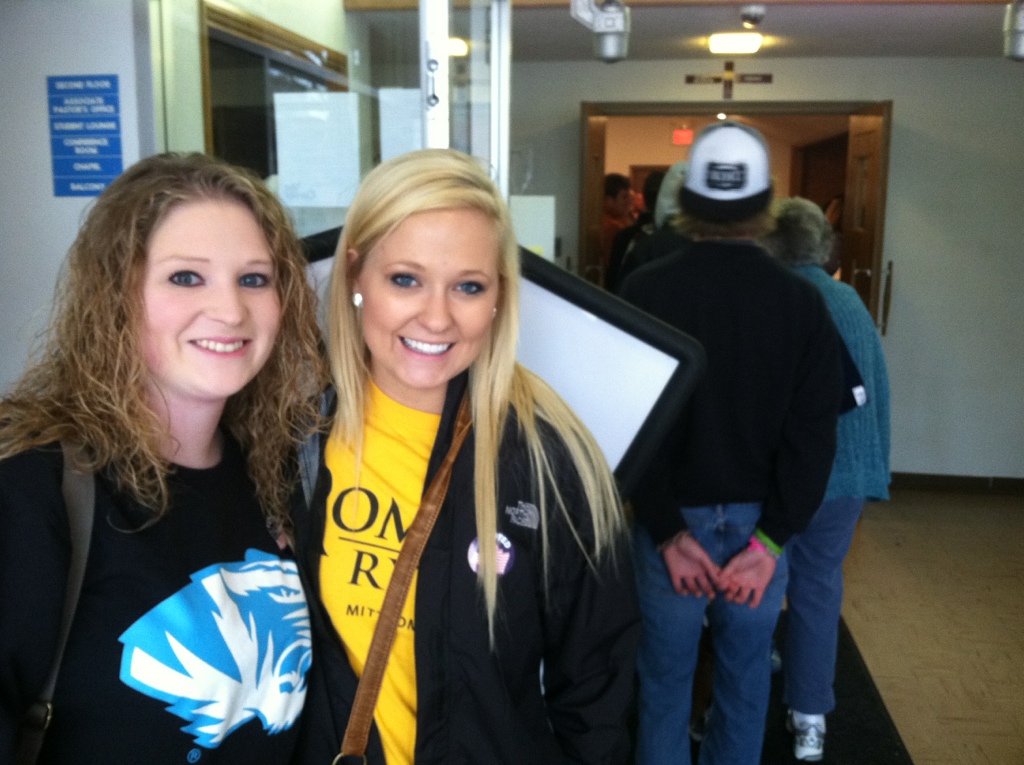
First-time voters Lauren Walker and Alabry Ewers drove together to Campus Lutheran Church to cast very different ballots.

“I voted for Romney,” Walker said, glancing at her friend. “And I did not,” Ewers replied, laughing.

But even though their votes effectively canceled each other out, they’re not mad — they’re not even peeved.

“We keep to ourselves about that,” Walker said, hugging Ewers to prove her point.

Walker, dressed in a yellow Romney/Ryan T-shirt, said her first time voting was a breeze. She waited in line “probably 5 minutes,” and said the paper ballot was “quick and easy.”

20121106-115532.jpg

A car pulls into the polling place at Campus Lutheran Church in Columbia, Mo. on Nov. 6, 2012. This polling place serves the predominately student-occupied area East of the University of Missouri.

20121106-120031.jpg

First-time voters Alabry Ewers (left) and Lauren Walker smile after casting conflicting ballots at Campus Lutheran Church, on Nov. 6, 2012 in Columbia, Mo. This polling place serves a student-dense area East of the University of Missouri campus; many of those students are voting for the first time.

Urban-issues columnist launches website to cover innovative solutions

(this article originally appeared June 7, 2012 on the East-West Center’s website)

by Adam A. Aton

HONOLULU –– The tendency of urban news media to focus on short-term problems and breaking events – while giving short shrift to promising long-term innovations and solutions ­– has been a “serious media failure,” leading urban-issues columnist Neal Peirce told a group of international journalists participating in the East-West Center’s Jefferson Fellowship study tour.

“Newspapers provide lots of urban crime, conflict and corruption stories,” said Peirce, whose syndicated weekly column for the Washington Post Writer’s Group appears in more than 50 newspapers.

Continue reading “Urban-issues columnist launches website to cover innovative solutions”

Assad’s Hail Mary: send in al Qaida

Image
Achileas Zavallis / AFP-Getty Images
(this post originally appeared Feb. 21, 2012 on the blog Designed Nostalgia)

by Adam A. Aton

In 2002, with US invasion forces chomping at the bit, Saddam Hussein flung open the doors of Abu Ghraib and loosed Iraq’s most dangerous criminals on Baghdad.

Hussein was telling the people one thing: Remember why I’m here, and remember what could happen if I go away. In large part, he was vindicated. When coalition forces swept Hussein aside, they discovered the pulsing sectarian tensions he worked so hard (and so violently) to tame—tensions that began expressing themselves through teenage suicide bombers and roadside IEDs—tensions that were still raw when the U.S. left Iraq, eight years later.

Syrian President Bashar al-Assad, facing a serious threat to his regime, took a page out of Saddam’s book. He too flung open the prison doors.

Continue reading “Assad’s Hail Mary: send in al Qaida”

My coverage of the 2012 International Media Conference in South Korea

Friends and lovers in South Korea leave personalized padlocks (and a few phone cases) arranged like pine trees encircling the Seoul Tower.

Articles

China’s support enables North Korea’s bad behavior

U.S. State Department increasingly turns to social media

Korean internet laws stifling innovation, failing to stop criminals

Social media shows promise in perilous stories

World Economic Forum unveils new internet guidelines for governments